Assessment |
Biopsychology |
Comparative |
Cognitive |
Developmental |
Language |
Individual differences |
Personality |
Philosophy |
Social |
Methods |
Statistics |
Clinical |
Educational |
Industrial |
Professional items |
World psychology |
Biological: Behavioural genetics · Evolutionary psychology · Neuroanatomy · Neurochemistry · Neuroendocrinology · Neuroscience · Psychoneuroimmunology · Physiological Psychology · Psychopharmacology (Index, Outline)
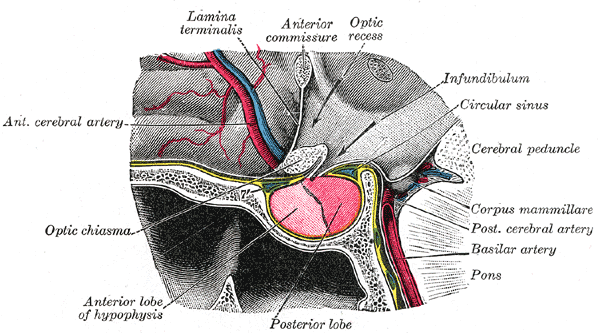

Located at the base of the skull, the pituitary gland is protected by a bony structure called the sella turcica.
The pituitary gland, or hypophysis, is an endocrine gland about the size of a pea that sits in the small, bony cavity (sella turcica) at the base of the brain. Its posterior lobe is connected to a part of the brain called the hypothalamus via the infundibulum (or stalk), giving rise to the tuberoinfundibular pathway. The posterior lobe is thus derived from neural ectoderm while the anterior lobe is derived from oral ectoderm. The anterior pituitary lobe receives releasing hormones from the hypothalamus via a portal vein system. The pituitary gland secretes hormones regulating a wide variety of bodily activities, including trophic hormones that stimulate other endocrine glands. For a while, this led scientists to call it the master gland, but now we know that it is in fact regulated by releasing hormones from the hypothalamus. It is physically attached to the brain by the pituitary, or hypophyseal stalk connected with the median eminence.
The pituitary gland is divided into two sections: the anterior lobe (adenohypophysis) and the posterior lobe (neurohypophysis). The posterior pituitary is, in effect, a projection of the hypothalamus. It does not produce its own hormones, but only stores and releases the hormones oxytocin and antidiuretic hormone (ADH - also known as vasopressin).
The anterior pituitary secretes growth hormone, prolactin, follicle-stimulating hormone, luteinizing hormone, thyroid-stimulating hormone, adrenocorticotropic hormone, endorphins and other hormones. It does this in response to a variety of chemical signals from the hypothalamus, including TRH (thyrotropin-releasing hormone), CRH (corticotropin-releasing hormone), DA (dopamine, "prolactin inhibiting factor"/PIF), GnRH (gonadotropin-releasing hormone), and GHRH (growth hormone releasing hormone), which travel to the anterior lobe by way of a special capillary system from the hypothalamus, down the median eminence, to the anterior lobe. These hormones from the hypothalamus cause release of the respective hormone from the pituitary, i.e. TRH releases TSH, CRH releases ACTH, GnRH releases FSH and LH and GHRH causes the release of GH except for DA, which constantly inhibits the release of prolactin normally. There is also an interaction between the hormones from the hypothalamus, i.e. TRH induces the release of prolactin. The control of release of hormones from the pituitary is in a negative feedback loop. Their release is inhibited by increasing levels of hormones from the target gland on which they act.
There is also an intermediate lobe in many animals. In adult humans it is just a thin layer of cells between the anterior and posterior pituitary, nearly indistinguishable from the anterior lobe. The intermediate lobe produces melanocyte-stimulating hormone (MSH), although this function is often (imprecisely) attributed to the anterior pituitary.
Functions[]
The pituitary gland helps control the following body processes:
- Growth
- Blood pressure
- Some aspects of pregnancy and childbirth
- Breast milk production
- Sex organ functions in both women and men
- Thyroid gland function
- The conversion of food into energy (metabolism)
- Water balance in the body
See also[]
- Growth hormone deficiency
- Hypopituitarism
- Acromegaly
- Pickardt syndrome
- Pituitary adenoma
- Sheehan syndrome
References & Bibliography[]
Key texts[]
Books[]
Papers[]
Additional material[]
Books[]
Papers[]
External link[]
- The Pituitary Gland, from the UMM Endocrinology Health Guide
- More information about the Pituitary gland from BrainInfo
Human anatomy, endocrine system: endocrine glands | |||||||||||||||||||||||||
|---|---|---|---|---|---|---|---|---|---|---|---|---|---|---|---|---|---|---|---|---|---|---|---|---|---|
| Hypothalamic/ pituitary axes |
| ||||||||||||||||||||||||
| Pineal gland |
Pinealocyte · Corpora arenacea | ||||||||||||||||||||||||
| Islets of pancreas |
Alpha cell · Beta cell · Delta cell · PP cell · Epsilon cell | ||||||||||||||||||||||||
| This page uses Creative Commons Licensed content from Wikipedia (view authors). |